
How to Write an AI Cat Soap Opera Script
Write the script as 5-second shots: a hook, a setup, a turn and a cliffhanger, with lines short enough to fit. Includes a full 60-second example.
Write an AI cat soap opera script as a shot list rather than prose: break the story into 5-second shots, give each shot one visible action and no more than about ten spoken words, and order the shots as hook, setup, turn and cliffhanger. In PawDrama you can pick a plot template and let the AI draft the script for 1 credit, then edit it, or paste your own and have it split into shots; plans start at the price on our pricing page.
Below you will find the structure, the line-length math, a layout for pasted scripts, a complete 60-second example you can adapt, and the problems that most often ruin a first draft.
The four beats of a soap opera episode
Short-form melodrama follows a simple engine. Every episode, whatever its plot, needs these four beats:
- Hook. The first shot drops the viewer into conflict. No establishing shots of the house, no "once upon a time".
- Setup. Who these cats are to each other and what one of them wants.
- Turn. Something changes: a betrayal is discovered, a secret comes out, the underdog strikes back.
- Cliffhanger. The final shot opens a new question instead of closing the old one.
Here is how many 5-second shots each beat usually gets at each episode length:
| Length | Shots | Hook | Setup | Turn | Cliffhanger |
|---|---|---|---|---|---|
| 15 s | 3 | 1 | 0 | 1 | 1 |
| 30 s | 6 | 1 | 1 | 3 | 1 |
| 60 s | 12 | 1 | 3 | 6 | 2 |
| 90 s | 18 | 1 | 4 | 10 | 3 |
At 15 seconds there is no room for setup, which is why short episodes suit gags and instant karma, where the situation explains itself.
How much dialogue fits in a 5-second shot
Conversational English runs at roughly 150 words a minute, or about two and a half words a second. A 5-second shot therefore holds about twelve words if someone talks the whole time, but a shot that is all talk feels crowded. Aim for six to ten words and let the last second breathe.
- Good: "You told me you were working late." (7 words)
- Too long: "I can't believe that after everything we went through together you would lie to my face like this." (19 words, split it across two shots)
Narration counts against the same budget. If the narrator speaks in a shot, nobody else should.
Rules for writing each shot
- One action per shot. "She opens the envelope" is one shot. "She opens the envelope, reads it, gasps and runs to the door" is three.
- Show it, then say it. If the husband hides his phone, film him hiding it. A line explaining that he hid it is wasted.
- Name every character in every shot. The AI cannot assume who "she" is in shot nine.
- Use simple camera words. Close-up, wide shot, over the shoulder. Those are enough.
- Change location rarely. Each new place is a new setting the model has to invent. Two or three locations per episode is plenty.
- Three characters per shot at most. That is the limit here, because each actor is a reference image. Four can share the episode, not the frame.
A layout for pasting your own script
You can paste plain text and it will be split into shots. A consistent layout helps the split land where you intended:
TITLE: The Stolen Recipe, Part 1
CAST: Pip (grey kitten), Nana (calico grandmother cat), Baron (black cat chef)

SHOT 1. Close-up. Baron reads a handwritten recipe card in a shiny restaurant kitchen.
BARON: "Grandma's secret fish pie. Mine now."

SHOT 2. Wide shot. A tiny cottage kitchen. Nana searches an empty recipe box.
NANA: "It was right here."
Speaker names in capitals, one SHOT line per 5 seconds, and dialogue on its own line. Keep stage directions short and concrete.
A complete 60-second example
Here is the rest of that episode, twelve shots, written to the beat table above. Use it as a model or paste it as it is.
- (Hook) Baron reads the stolen recipe card. BARON: "Grandma's secret fish pie. Mine now."
- (Setup) Nana searches an empty recipe box in her cottage. NANA: "It was right here."
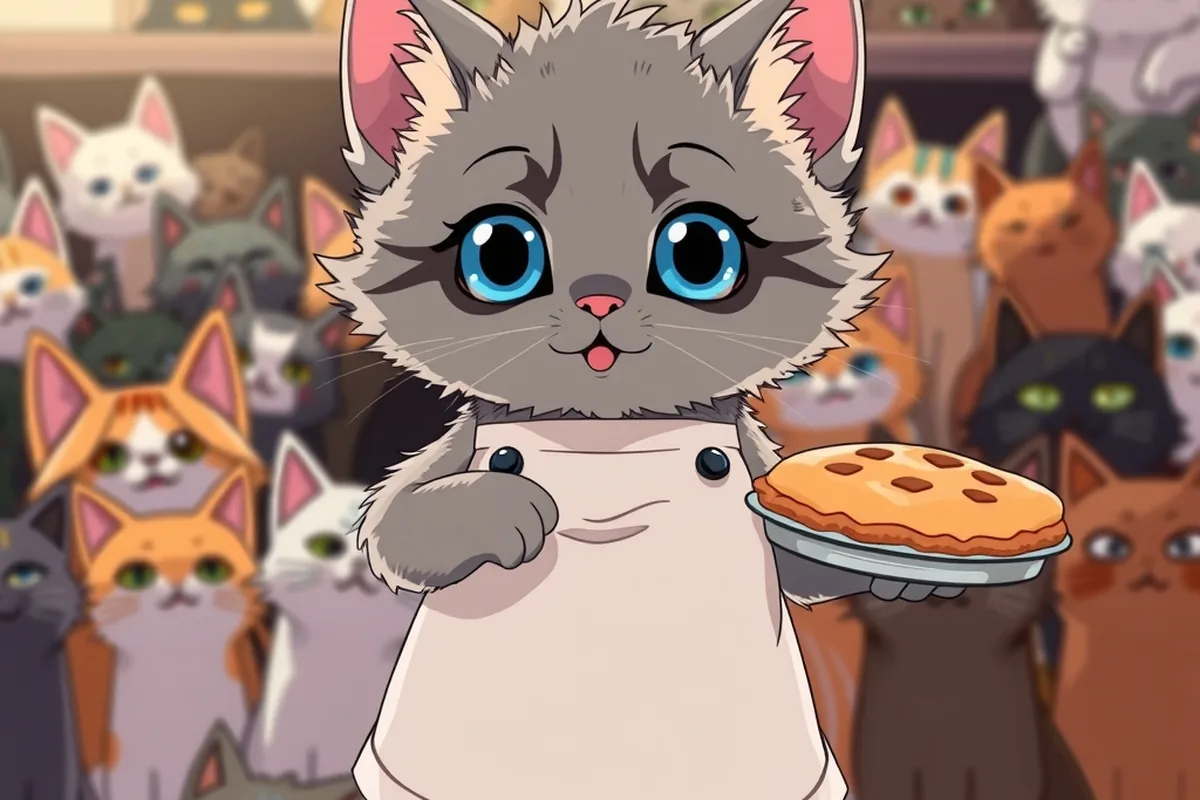
- (Setup) Pip, in a too-big apron, hugs Nana. PIP: "We'll make it from memory."
- (Setup) A poster on a lamppost: Town Pie Contest, Saturday.
- (Turn) Contest day. Baron sets a perfect fish pie on the judges' table to applause.
- (Turn) Pip carries a lopsided pie with both paws. The crowd laughs.
- (Turn) Close-up of the judge, an old corgi, tasting Baron's pie. JUDGE: "Hmm. Familiar."
- (Turn) The judge tastes Pip's pie and freezes. JUDGE: "This is Nana's recipe."
- (Turn) Baron's smile drops. BARON: "That's ridiculous. It's mine."
- (Turn) Pip holds up a faded photo of Nana baking the same pie years ago. The crowd gasps.
- (Cliffhanger) Nana steps forward and stares at Baron. NANA: "I know who you are."
- (Cliffhanger) Baron goes pale. NARRATOR: "Baron had a secret older than the recipe."
Notice that the cliffhanger does not explain anything. It promises Part 2.
Endings that bring viewers back
Four kinds of cliffhanger work in almost any plot:
- The reveal: someone says "I know who you are" or a letter shows a name.
- The arrival: a door opens and a character we thought was gone walks in.
- The threat: the villain makes a call and says "Do it tonight."
- The question: the narrator asks what no one in the scene knows yet.
When you write Part 2, pay off the cliffhanger within the first two shots, then add one new problem. "Make Part 2" in PawDrama carries a summary of the previous episode into the next script, so the AI knows what has to be answered.
Problems that sink a first draft
| Problem | Why it fails | Fix |
|---|---|---|
| Slow opening | Viewers scroll before the drama starts | Start on the conflict, explain later |
| Speeches | The line runs longer than the 5-second shot | Split anything over ten words |
| Pronouns everywhere | The AI guesses who is in the shot | Use names in every shot |
| Too many locations | Every new place is a new guess | Two or three settings per episode |
| Tidy ending | No reason to watch the next part | End on a question |
Using the AI draft as a starting point
If you pick a plot template, the script generator writes dialogue, narration and a shot list for the length you chose. Treat it like a first draft from a writing partner: tighten the lines, rename the characters, swap in a detail from your own pet's life, and sharpen the last shot. Each draft costs 1 credit, so asking for a second version is cheap. Nothing is rendered until you press generate.
What to keep out of the script
Melodrama is fine; some content is not. Scripts are checked before anything is generated, and these are refused: sexual content, gore, hate, anything involving minors, impersonation of real people, and copyrighted characters or brands. A cheating plot works as drama without being explicit. Keep every character an animal or object; human characters based on real people are not supported.